LED light therapy is one of the most heavily marketed things in skincare and one of the least clearly explained. It turns up as an add-on in clinics, as a $600 mask in an online ad, and as a feature on devices that cost twenty dollars.
This guide covers what it actually is, how it is used at Enrich Aesthetics in Wangi Wangi, and how to read the claims made about it. That last part matters more than usual here, because this is a category where the marketing has run a long way ahead of the plain explanation.
What is LED light therapy?
LED stands for light-emitting diode. LED light therapy applies specific wavelengths of visible and near-infrared light to the surface of the skin.
Different wavelengths sit at different points on the visible spectrum and reach different depths. That is the entire mechanical premise: light of a particular wavelength, delivered to the skin, for a set period.
It involves no needles, no incision and nothing applied under the skin. It is a surface treatment.
Is it the same as UV, or a sunbed?
No, and this is the single most common misunderstanding.
Ultraviolet radiation is the part of the spectrum associated with sunburn, photoageing and skin cancer risk. It is what a sunbed produces, and it is what sun protection exists to manage. LED devices used in skin treatment do not emit ultraviolet light.
Given how much cumulative sun exposure the average person around this lake accumulates, this distinction is worth being clear about. If you are worried about UV, the thing to think about is your daily routine outdoors, not an LED panel. There is a fuller guide on that in how Lake Macquarie’s outdoor lifestyle affects fine lines and wrinkles.
Is it the same as a laser?
Also no.
A laser produces coherent light: a single wavelength, focused, travelling in one direction. That is what allows lasers to be targeted precisely and to deliver significant energy to a small area.
LEDs produce non-coherent light across a wavelength range, spread across the surface rather than focused. They are a different technology used for different purposes, and a clinic describing an LED device in laser terms is either being careless or hoping you will not notice.
In-clinic LED versus an at-home mask
This is the question people actually want answered, and the honest response has a few parts.
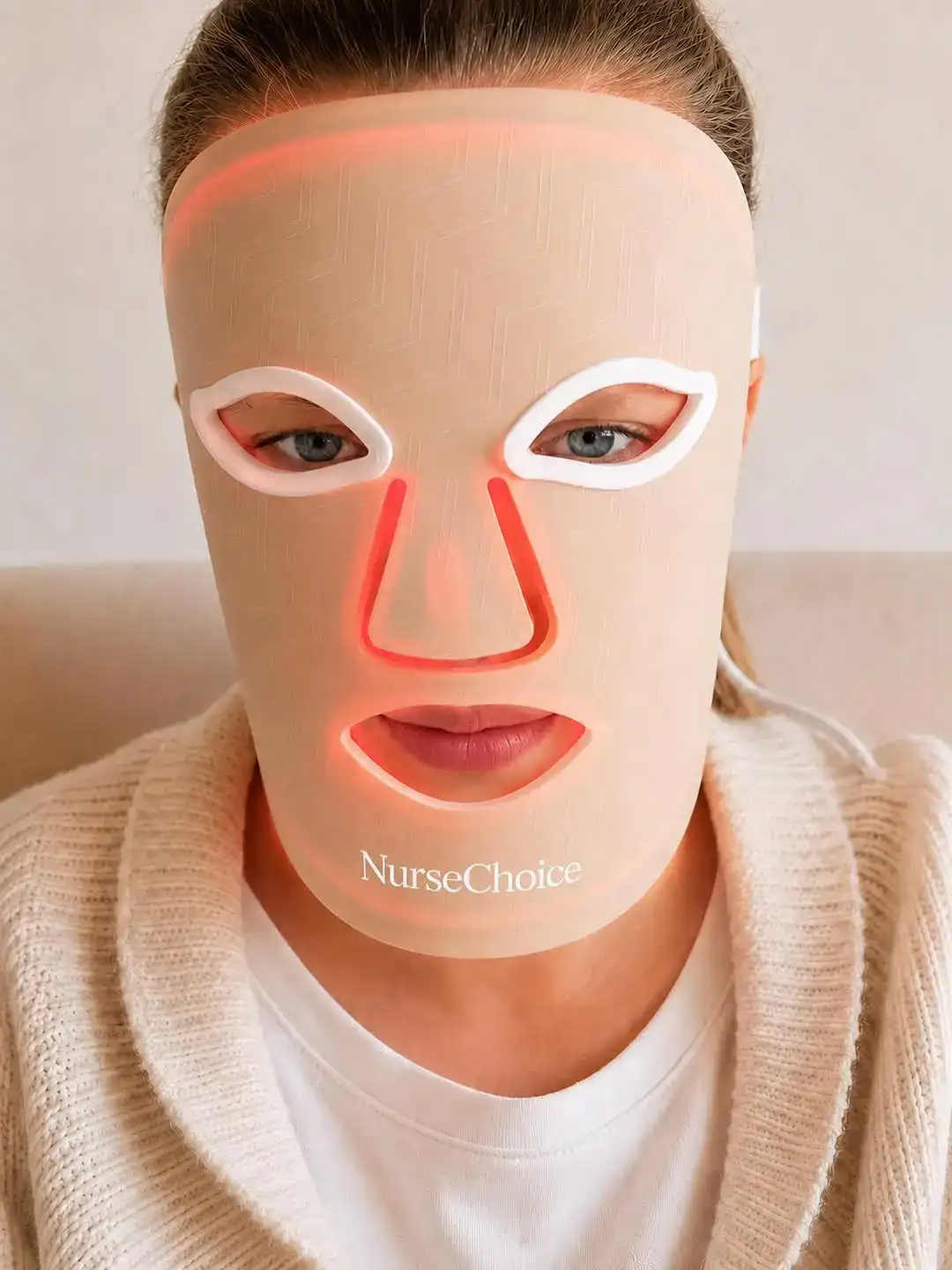
They are not the same category of device. Clinic units are generally larger, higher output, and used in a controlled setting for a set duration under supervision. Home masks are lower output, designed for unsupervised use, and depend entirely on the person actually using them.
That last point does more work than most comparisons admit. A home device used consistently and a clinic device used occasionally are genuinely difficult to compare, because the variable that changed is not the hardware.
What is worth checking before you buy anything:
- Whether the device is included in the Australian Register of Therapeutic Goods, which is publicly searchable and maintained by the TGA
- What wavelengths it actually outputs, stated as numbers rather than as colour names
- What the manufacturer’s directions for use actually say, including duration and frequency
- Whether the seller can answer any of the above without redirecting you to a testimonial
Enrich stocks Nurses Choice LED masks for home use, and uses a Nurses Choice LED dome in clinic, either added to another treatment or as a session on its own. If you are weighing one against the other, that is a reasonable conversation to have at an appointment rather than in a checkout.
A category where the marketing has run this far ahead of the plain explanation deserves more scepticism, not less.
How LED is used at Enrich
It is used most often alongside other treatments, commonly with chemical peels, rather than sold as the answer to a skin concern on its own.
LED is $60 added to another treatment, or $95 as a 30 minute session on its own.
That framing is deliberate. LED is a supportive part of a plan. It is not the plan, and a clinic positioning it as the centrepiece of your skin health is describing a business model rather than a clinical approach.
Whether it adds anything to what you are already having done is discussed at your appointment, in the context of everything else being considered. Sometimes it does. Sometimes the honest answer is that your money is better spent on sun protection and a routine you will actually keep up with.
How to read the claims
Here is where a nurse-led clinic has to write differently from the rest of the category, and it is worth explaining why.
Devices supplied in Australia for therapeutic purposes are regulated by the TGA, and what may be claimed about them in advertising is constrained by the Therapeutic Goods advertising rules. Separately, AHPRA’s guidelines for advertising higher risk non-surgical cosmetic procedures, in effect since 2 September 2025, restrict registered practitioners from using language that minimises a procedure or promises psychological benefit.
So when you are comparing pages, a few things are worth noticing:
- Specific outcomes on specific timelines, stated without qualification
- Language that flattens any procedure into something trivial
- Claims about how a treatment will make you feel about yourself
- Before and after imagery presented without context
- Any suggestion that one device is the reason a result happened, when a plan involved several things
None of that means a treatment does not do anything. It means the page you are reading is advertising rather than explaining, and you should weight it accordingly.
What gets checked before light-based treatment
The same things checked before anything else at the clinic.
Your relevant medical history, current medications, allergies, previous treatments, and what you are actually trying to address. Assessment happens in person, because that is the only way to see the skin in question and the only way to have a sensible conversation about whether something is worth doing at all.
There is no version of this where a treatment is appropriate because you asked for it by name.
Questions worth asking
Wherever you go, and about any device:
- What wavelengths does this device output?
- Is it included in the ARTG?
- What is it being used alongside, and why?
- What would you expect it to contribute, and what would you not?
- What would make you tell me this is not worth adding?
- What does it cost, and what does it cost as part of a package rather than on its own?
A practitioner who answers those directly is giving you more than a page of benefits ever will.
Booking and practical details
Enrich Aesthetics is at 22 French Rd, Wangi Wangi, on the western side of Lake Macquarie, with clients travelling in from Toronto, Rathmines, Coal Point, Carey Bay, Morisset and Warners Bay.
Appointments run 9am to 5pm Monday to Saturday, closing at 3pm on Thursdays. The clinic is appointment-only rather than a walk-in space. There is parking in the driveway at the front of the clinic or on the street, and parking details are sent through with your appointment confirmation the day before. Website enquiries are answered within 24 hours.
For the wider picture of how LED fits alongside peels, collagen support and skincare, start with the skin rejuvenation guide.
This guide is general education. It is not medical advice, and it does not replace an in-person consultation.