
Almost every article on this subject makes the same mistake. It treats skin ageing as a single process, running on a single clock, happening in a single layer.
It is at least four processes, in four layers, on four different timelines. And in Australia a large share of what people identify as ageing is not chronological at all.
Getting the distinction clear is genuinely useful, because it tells you which concerns have an available answer, which will improve with habits, and which are structural and outside what any cosmetic clinic can alter.
The four layers
From the outside in.
Skin. The surface. Cell turnover slows, the barrier becomes less efficient, pigmentation accumulates, and the collagen and elastin that give skin its firmness and recoil decline. This is the layer everything marketed at you is aimed at, and it is only the first of four.
Fat. Facial fat is not a single even layer. It is arranged in distinct compartments, and they do not behave uniformly. Some lose volume, some descend, and they do so at different rates, which is why the change reads as a shift in facial shape rather than as simple deflation.
Muscle. Repeated movement over decades folds the skin above it in consistent places. That is why expression lines appear where your particular face moves most, and why two people the same age have them in different places.
Bone. The part almost nobody knows about. The facial skeleton changes with age. Eye sockets widen, the midface loses projection, the jaw changes shape. Skin and fat that were supported by a particular structure are now supported by a slightly different one.
Nothing you apply to your face reaches the bottom two of those. Anything claiming otherwise is describing the first layer and implying the rest.
The Australian asterisk
Before any decade breakdown, the caveat that matters more than the breakdown does.
A great deal of what is described as ageing in Australian skin is cumulative ultraviolet exposure. It produces pigmentation, coarse texture, broken capillaries and deeper lines, and it accumulates from childhood.
Which means a decade-by-decade guide describes averages that any individual sun history can shift substantially in either direction. Someone who spent every summer of their childhood on the water at Newcastle or around Lake Macquarie and someone who did not are not on the same curve, whatever their birthdays say.
That is also the good news, because it is the modifiable part. Genetics sets a baseline you cannot alter. Ultraviolet exposure is the largest factor you can. The guide on how the outdoor lifestyle here affects skin covers the local version of this.
Two people the same age can be a decade apart on the face, and the variable is usually sun rather than genetics.
The twenties
Collagen production begins declining from around the mid twenties, at a rate commonly cited as roughly one percent a year. Nothing is visible. The framework is simply no longer being replaced quite as fast as it is used.
What people actually notice in this decade is skin behaviour rather than ageing: oiliness, congestion, breakouts, reactivity, and the after-effects of a routine that has too much in it.
What is quietly determining the next thirty years is sun exposure, and whether smoking is part of the picture. The habits formed here matter more than anything bought here.
A consultation in your twenties is a reasonable thing to have and it is not a prerequisite for anything. What it typically produces is an assessment of what your skin is doing and a clear answer about whether anything needs addressing at all. Frequently the answer is no.
The thirties
The decade where most people first notice something.
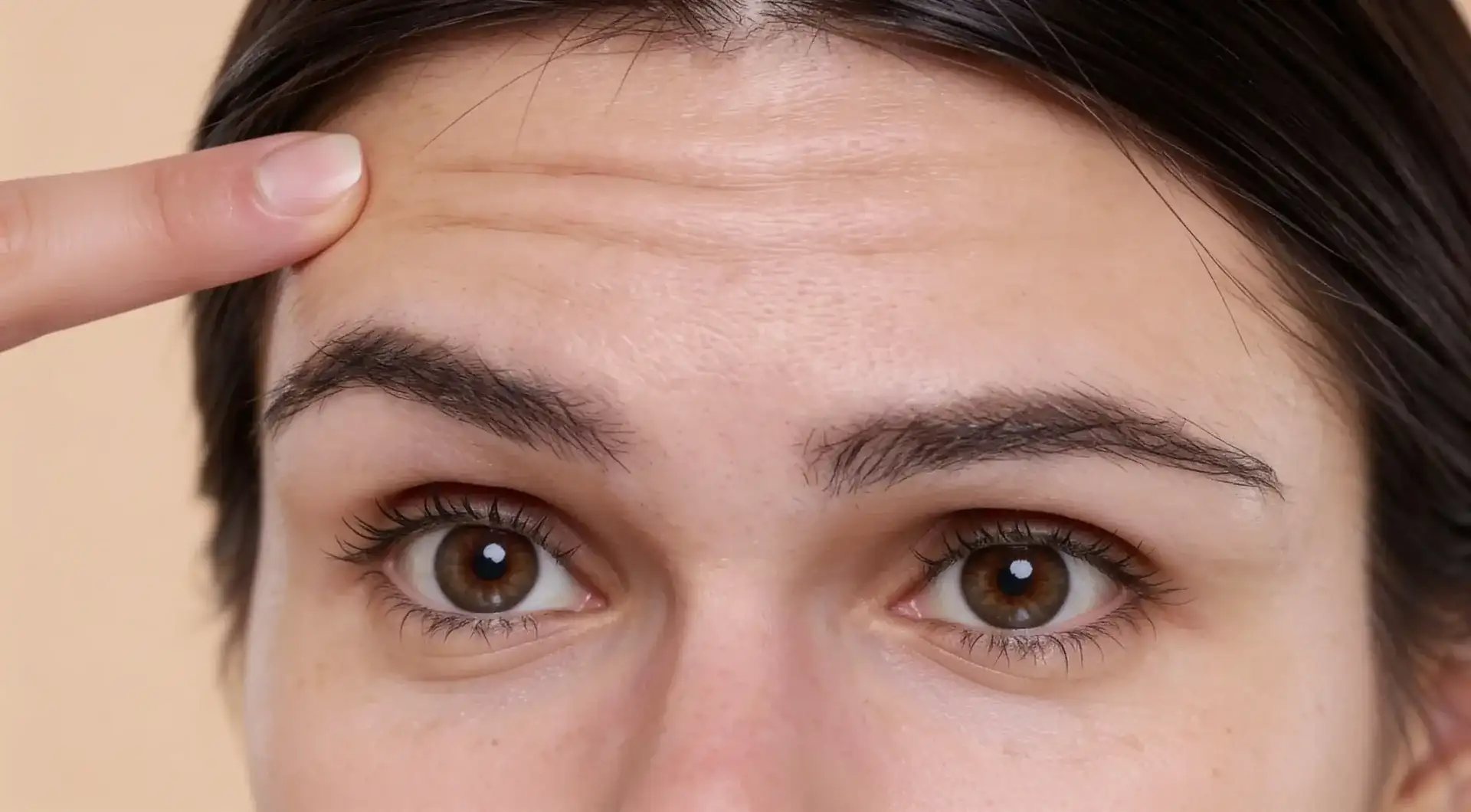
Expression lines start becoming visible at rest rather than only on movement. That transition has a name and a mechanism: a dynamic line is produced by muscle movement, and over years, as the skin’s collagen and elastin decline, the fold can persist into a static line visible when the face is relaxed. The guide on static and dynamic lines explains why the distinction drives the entire assessment.
Sun damage from earlier decades begins surfacing as pigmentation, which is why so many people describe spots appearing suddenly on a face that has been accumulating them for twenty years.
Skin also tends to become drier as the decade progresses, and the routine that suited oily skin at twenty-five is often actively unhelpful at thirty-eight.
For those who have been pregnant, this is also where melasma commonly enters the picture, and it does not necessarily leave with the pregnancy.
The forties
The steepest decade for most people, and the one where several things arrive together.
Perimenopause commonly begins in the mid to late forties. Falling oestrogen affects collagen, oil production, water retention and skin thickness simultaneously, which is why the change is experienced as a step rather than a gradual slope. That has its own dedicated guide, because it deserves more room than a paragraph.
Structurally, facial fat compartments are losing volume and descending at differing rates. The visible result is usually described as flatness through the cheeks and a softening jawline rather than as lines, which is a different kind of change entirely. The guide on volume changes in the cheeks and jawline covers what that involves.
Under-eye changes become more noticeable as the skin thins and the supporting structure alters, and that area has its own dedicated guide. Static lines are established. Pigmentation is more visible.
This is also the decade in which people most often arrive having spent significant money on products aimed at the surface for concerns that are not on the surface.
The fifties and beyond
Post-menopause, the rate of collagen loss slows again after the sharper decline of the transition years. Skin is thinner, drier and slower to recover from irritation, which affects what is appropriate and how cautiously anything is introduced.
Bone changes become a more meaningful part of the picture. Skin laxity is more evident, because there is both less collagen and less structural support beneath it.
Accumulated sun damage is at its most visible, which makes this a decade where the boundary between cosmetic and medical matters. Any spot that is changing, has an irregular border, itches or bleeds is a question for a GP or skin cancer clinic first.
What a consultation does with all this
It sorts your particular face into categories, which is more useful than any decade average.
- What is surface, and may respond to skincare and sun protection
- What is structural, and does not
- What is sun damage, which is a different conversation from chronological change
- What is dynamic versus static, which changes how a line is assessed entirely
- What is not worth doing anything about, which is a real category and one that gets stated
Skin quality is worth separating from the other four as well, since it is a different thing again from lines, volume and pigmentation. That is the ground Rejuran covers, and it is assessed rather than assumed to be the starting point.
Kirsty assesses the whole face rather than the area you named, because these layers interact. A change in the midface affects how the lower face reads, and reading one area in isolation is how a proportionate outcome gets missed. The guide on what natural results actually means covers why that matters.
The uncomfortable part
Decade-by-decade content is popular because it implies a schedule: turn forty, buy the forties routine.
Faces do not work that way. They age at rates set by genetics, sun exposure, skin type, health, sleep, smoking and hormones, and two people at the same birthday can be years apart on the face.
So this guide is a description of common patterns, not a prescription. What changes between decades is usually which questions are worth asking, not which products belong on a shelf.
And some of what changes is not addressable, which is worth saying on a page that could readily imply otherwise. Bone changes are not reversible. A face that has changed shape has changed shape. A practitioner who tells you that plainly is giving you better information than one who has something for every item on the list.
About this clinic
Enrich Aesthetics is a single-practitioner, nurse-led clinic at 22 French Rd, Wangi Wangi, on the western side of Lake Macquarie, seeing clients from across Newcastle and the lake.
Kirsty Neagle is a Registered Nurse (Division 1) holding general registration with the Nursing and Midwifery Board of Australia, first registered in 2001. AHPRA registration NMW0001646562, verifiable on the public AHPRA register.
Appointments run 9am to 5pm Monday to Saturday, closing at 3pm on Thursdays. Clients travel in from Charlestown, Kotara, Adamstown, Cooks Hill and around the lake from Toronto and Belmont.
The short version
Four layers, four timelines, and an Australian sun history sitting on top of all of them.
Skin thins and loses collagen from the mid twenties. Lines cross from dynamic to static in the thirties. The forties bring hormonal change and structural change together, which is why that decade feels abrupt. The fifties are steadier but working with less underneath.
Knowing which layer a concern belongs to tells you whether it has an answer, and that is a more useful thing to walk into a consultation with than a birthday.
This guide is general education. It is not medical advice, and it does not replace an in-person consultation.