
Most people who book a consultation about pigmentation describe it the same way. There are patches. They were not there before. They got worse over summer.
That description covers at least three separate conditions, and they do not behave alike. One tends to fade on its own. One responds reasonably well to a considered approach. One is a chronic, hormonally driven condition that recurs no matter how well it is handled.
Working out which one is in front of you is the entire point of the assessment, because the same approach applied to the wrong type can make things worse.
The three you are most likely to have
Sun-related pigmentation. Discrete, reasonably well defined marks in the places light lands hardest: cheekbones, the bridge of the nose, forehead, upper lip, and the backs of the hands. They accumulate over decades rather than appearing in one season, which is why people often notice them suddenly despite them having formed slowly. This is the most common form around Lake Macquarie, for reasons covered further down.
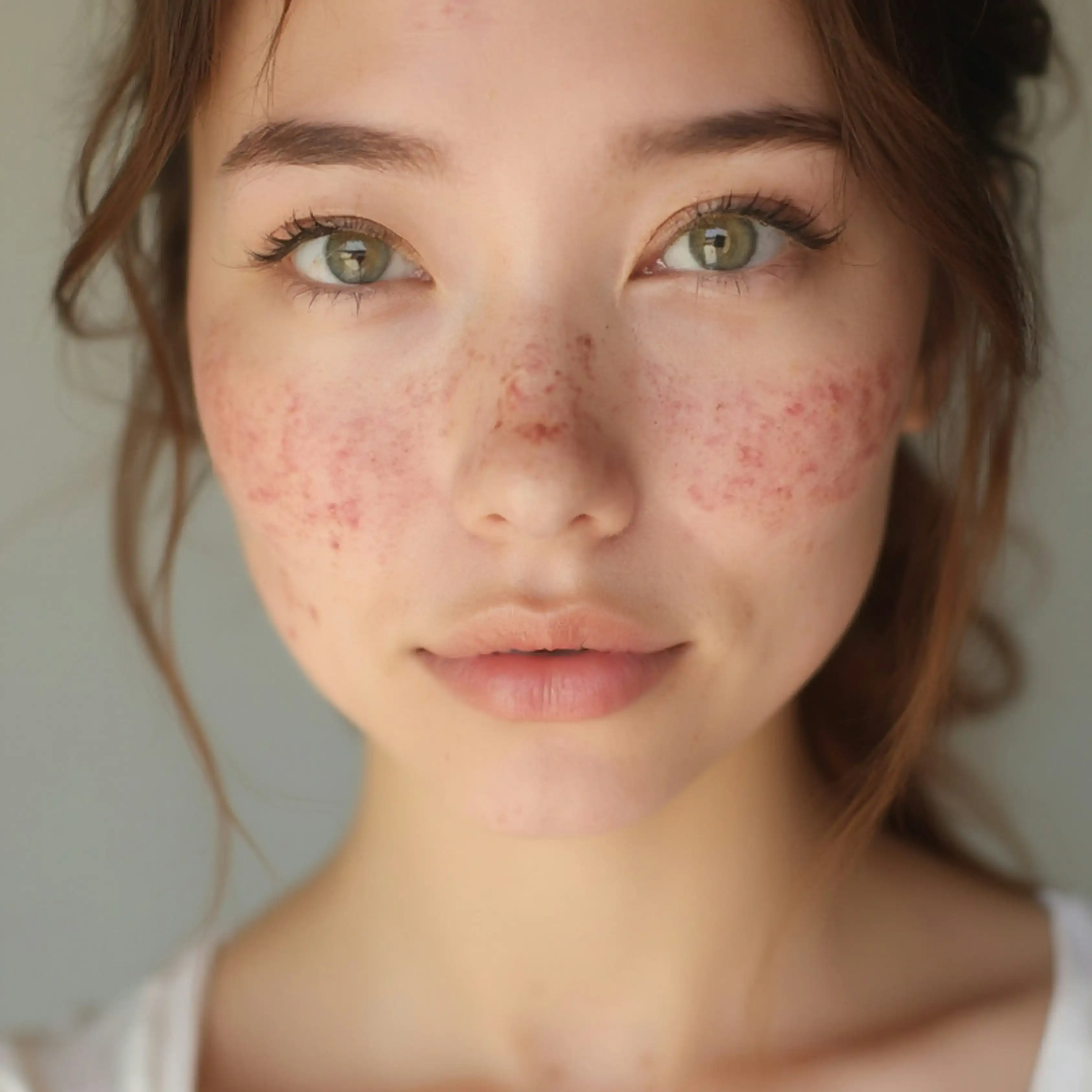
Melasma. Larger, blotchier, softer edged, and usually symmetrical, appearing across both cheeks, the forehead or the upper lip in a mirrored pattern. It is driven by a combination of hormones, heat and light. Pregnancy, the oral contraceptive pill and hormone replacement are all common triggers, which is why it is sometimes called the mask of pregnancy. It is far more common in women, and more common again in deeper skin tones.
Post-inflammatory pigmentation. A flat brown or grey mark left behind where the skin was inflamed: a breakout, a scratch, an ingrown hair, a reaction to a product. It is not a scar. It is pigment deposited during the healing process, and in many cases it fades on its own over months without anything being done to it.
There are others, including freckles, which are genetic rather than acquired, and pigment changes associated with certain medications. But those three account for most of what walks through a cosmetic clinic door.
Why the distinction changes what happens next
Post-inflammatory pigmentation frequently needs time and sun protection more than it needs a treatment. Treating it aggressively while it is still settling can cause more inflammation, which causes more pigment, which is the exact problem you were trying to solve.
Sun-related pigmentation sits at a relatively predictable depth and is generally the most straightforward of the three to approach, though “straightforward” still means a series rather than a single visit.
Melasma is the difficult one, and any clinic telling you otherwise is not being straight with you. It sits at varying depths, it is fed by hormones that a topical or in-clinic approach cannot change, and it flares with heat as well as with light, which means even the warmth of a treatment can be a trigger. The clinical goal with melasma is control and maintenance over years, not resolution.
An approach that helps one form of pigmentation can worsen another. That is the whole reason it gets assessed rather than treated on description.
The Lake Macquarie factor
There is a reason pigmentation is one of the most common concerns raised at this clinic.
Life around the lake is spent outdoors and near water, and water reflects ultraviolet light back up at you. So does the pale sand at Blacksmiths and along the eastern beaches. Someone who spends weekends on a boat out from Rathmines or Wangi Wangi is receiving exposure from above and from below simultaneously, on a face that is already looking up.
Cloud cover is not much protection either. A significant proportion of ultraviolet passes straight through cloud, which is why people who are careful in January and relaxed in June still accumulate damage year round.
The companion guide on how the outdoor lifestyle here affects the skin covers the ageing side of the same exposure. Pigmentation is the other half of it.
What actually gets assessed
At a consultation about pigmentation, Kirsty is working through a set of questions before anything is proposed.
- The pattern. Symmetrical and blotchy points one way, scattered and discrete points another.
- The borders. Well defined edges and diffuse edges suggest different things.
- The distribution. Where on the face, and does it match sun exposure or does it match a hormonal pattern.
- The history. When it appeared, what was happening at the time, whether it fluctuates.
- Hormonal factors. Pregnancy, contraception, hormone therapy, perimenopause.
- Medications. Several increase photosensitivity.
- Your current routine. What is actually in it, including anything active you have started recently.
- Your skin type, including how your skin has historically responded to injury or inflammation.
That last one carries real clinical weight. Deeper skin tones, including Asian, Middle Eastern, African and Southern European skin, are more prone to depositing pigment in response to inflammation. That changes what is appropriate and how cautiously it can be introduced. It is assessed individually, in person, rather than ruled in or out from a website.
Where in-clinic options fit
Chemical peels are one of the options assessed for some pigmentation concerns. Kirsty works primarily with lactic and salicylic acid, and the choice between them and the strength used is a decision made after looking at your skin, not a default applied to everyone who books.
Two honest caveats belong here.
The first is that pigmentation almost always suits a series rather than a single appointment. A course of six to eight peels spaced fortnightly to monthly gives a more controlled result than one aggressive session, and the controlled version matters more with pigmentation than with almost any other concern, because overshooting causes the exact problem you came in about.
The second is that for melasma specifically, restraint is not optional. Heat and inflammation are triggers for the condition itself. An approach that is too strong or too fast can deepen the pigmentation rather than lift it.
For some people the answer at consultation is that an in-clinic option is not appropriate at all right now, and the useful work is in the daily routine instead.
The part nobody wants to hear
Sun protection is not the boring afterthought at the end of a pigmentation conversation. It is the main event.
Every form of facial pigmentation described above is stimulated by ultraviolet exposure. Improving pigmentation without changing daily exposure is filling a bath with the plug out. Any clinic that sells you a course of anything for pigmentation and does not spend serious time on daily protection has skipped the part that determines whether the rest of it holds.
Daily, year round, including in winter, including on overcast days, and reapplied when you are outside for any length of time. Heat and visible light matter for melasma as well, which is why shade, a hat and getting off the water in the middle of the day do real work that a bottle cannot do alone.
When it is not a cosmetic question
One boundary worth stating plainly.
A mark that is changing in size, shape or colour, that has an irregular or asymmetric border, that itches or bleeds, or that simply looks unlike every other mark on your skin, is a question for your GP or a skin cancer clinic. Not for a cosmetic consultation.
Australia has the skin cancer rates it has, and the Hunter is not an exception to that. A cosmetic clinic assesses cosmetic pigmentation. Anything that belongs with a doctor gets said at the consultation rather than treated, and that is the correct outcome rather than a failed appointment.
About this clinic
Enrich Aesthetics is a single-practitioner, nurse-led clinic at 22 French Rd, Wangi Wangi, on the western side of Lake Macquarie. The nurse who assesses you is the same one who treats you at every visit.
Kirsty Neagle is a Registered Nurse (Division 1) holding general registration with the Nursing and Midwifery Board of Australia, first registered in 2001. AHPRA registration NMW0001646562, verifiable on the public AHPRA register.
Appointments run 9am to 5pm Monday to Saturday, closing at 3pm on Thursdays. Clients travel in from Toronto, Rathmines, Kilaben Bay, Morisset, Warners Bay, Speers Point, Belmont and across Newcastle.
The short version
“Pigmentation” is three or four different conditions wearing the same coat. Sun damage, melasma and post-inflammatory marks look alike across a bathroom mirror and want quite different handling, and melasma in particular is managed rather than solved.
Get it identified before anything is done to it, expect a series rather than a single visit, and understand that the daily sun protection is not the small print. It is the thing that decides whether any of the rest was worth doing.
This guide is general education. It is not medical advice, and it does not replace an in-person consultation.