Two people describe their skin identically. Tight after cleansing. Flaky in patches. Nothing seems to sink in.
One of them has dry skin. The other has dehydrated skin. They need close to opposite things, and the person who gets it wrong usually spends six months and a few hundred dollars making it worse.
Underneath both sits the skin barrier, which is the part of this that actually matters and the part almost nobody arrives knowing about.
The distinction, plainly
Dry skin is a type. It produces less oil than it needs. It tends to be lifelong, it usually shows up on the body as well as the face, and it often runs in families. Dry skin in your twenties is generally dry skin in your fifties, though it can become more pronounced with age as oil production naturally declines.
Dehydrated skin is a state. It lacks water, not oil. It comes and goes. It can be caused by weather, air conditioning, salt water, chlorine, alcohol, illness, a long flight, or a skincare routine that is stripping more than it is giving back.
The crucial consequence: oily skin can be dehydrated. This is one of the most common mismatches seen at consultation. Someone reports shine through the day and tightness after cleansing, concludes the shine is the problem, and escalates to stronger foaming cleansers and stronger oil-control actives. The skin loses more water, the tightness worsens, and often the oil production increases in response. The routine designed to fix the problem is now the problem.
What the skin barrier actually is
The outermost layer of your skin is a thin, tough structure, usually described as brick-and-mortar: skin cells as the bricks, a mix of lipids including ceramides, cholesterol and fatty acids as the mortar holding them together.
It does two jobs at once. It keeps water in and it keeps irritants, allergens and microbes out.
When it is working, skin tolerates weather, water and products without complaint. When it is compromised, water escapes faster than it can be replaced and things that were previously harmless get in and cause a reaction. That is why a damaged barrier presents as dehydration and sensitivity simultaneously: they are two symptoms of the same failure.
Skin that has suddenly stopped tolerating a product it used a hundred times has almost always told you something about its barrier, not about the product.
Signs the barrier is compromised
Commonly reported, and worth raising at a consultation:
- Stinging or burning on application, particularly with products that never used to sting
- Tightness that does not settle after moisturising
- Redness that is new, or that lingers longer than it used to
- Rough patches, flaking, or a texture that feels like fine sandpaper
- Skin that looks dull despite an active routine
- Breakouts alongside dryness, which feels contradictory and is not
- A sudden reaction to a product that has been in your routine for months
That last one is the most diagnostic. A product does not usually change. The skin’s tolerance does.
What causes it, in a cosmetic context
Weather, ageing, medical skin conditions and genetics all play a part. But in a cosmetic clinic, the overwhelmingly common cause is simpler.
Doing too much.
The pattern repeats with striking consistency. A vitamin C in the morning. A retinoid at night. An exfoliating acid two or three evenings a week. A clay mask on Sundays. A cleansing brush. A new peel booked in for Thursday. Every one of those defensible on its own, and collectively a sustained assault on the mortar between the bricks.
Social media has made this considerably worse, because each product is recommended by someone who is not looking at your face and is not aware of the other six things you are already using.
The other common route is escalation: a concern is not improving, so the response is more frequency or higher strength, when the reason it is not improving is that the barrier underneath is not intact.
Why this belongs in a cosmetic consultation
It is not a side conversation. It changes what can be done.
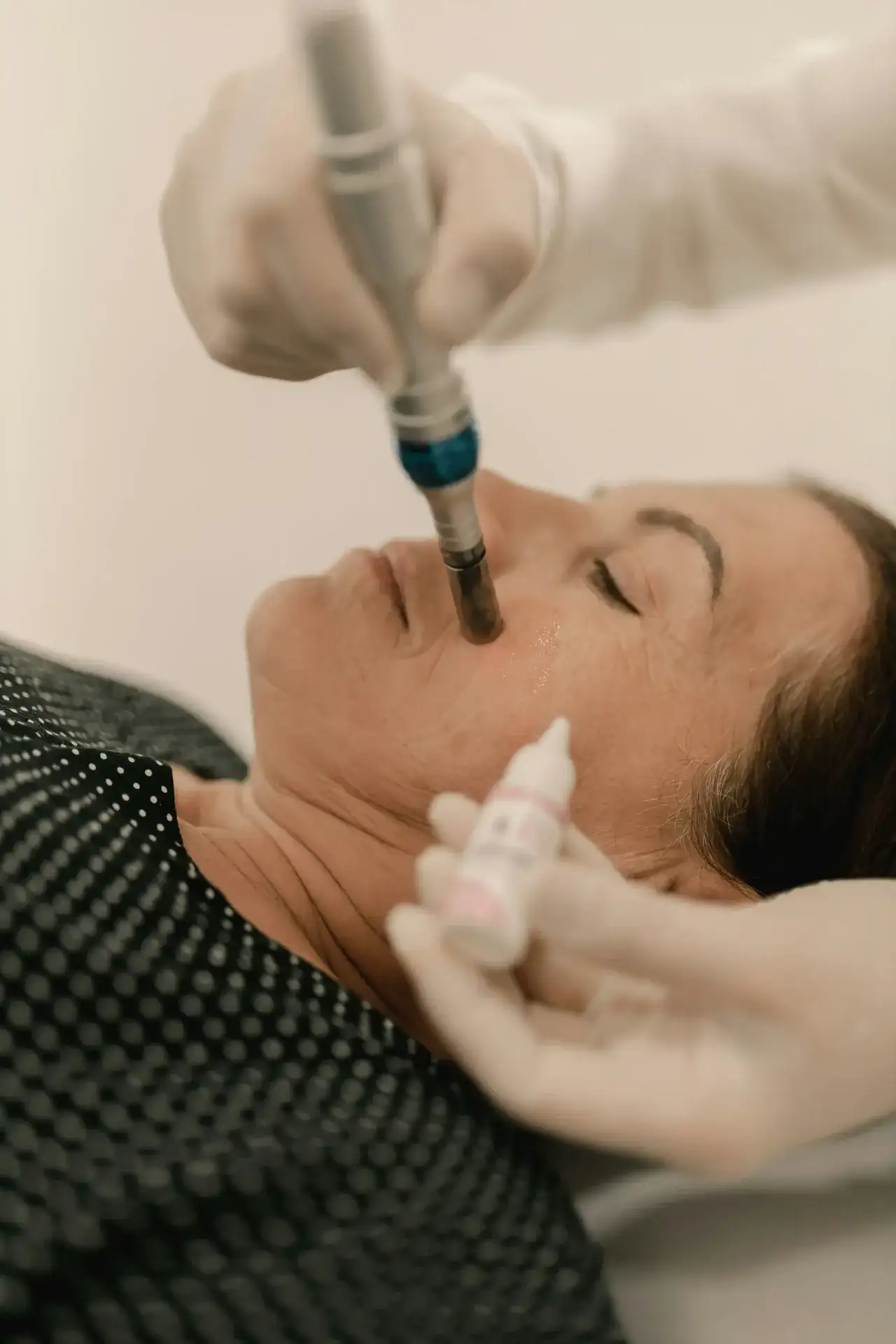
Chemical peels are a controlled exfoliation. Skin needling is a controlled injury. Both rely on a barrier that is capable of recovering in a predictable way. Performing either on skin that is already struggling turns a straightforward appointment into weeks of irritation, and with some skin types it also raises the risk of post-inflammatory pigmentation afterwards.
So the barrier gets assessed before anything is recommended, and being told to wait is a legitimate and reasonably frequent outcome. Kirsty also asks what is actually in your current routine, including anything active, because retinoids and acids at home usually need pausing before a peel regardless of how well your skin is behaving.
What recovery generally involves
The principle is subtraction before addition.
Stop the cause. A repair product layered on top of the routine that caused the damage is not a fix. The routine is the variable that has to change.
Simplify. A simple non-stripping cleanser, a moisturiser, and sun protection is a complete routine while skin is recovering. It is not an exciting one, and it is what most people need for a period of weeks.
Do not test it. The temptation to reintroduce an active as soon as things feel better is strong, and it is the most common reason people cycle in and out of the same problem for a year.
Reintroduce one thing at a time. If a reaction happens, you then know what caused it. Reintroducing three at once gives you no information at all.
Sun protection stays. Compromised skin is less able to defend itself, and this remains true on overcast days.
Timeframes vary between individuals, and anyone giving you a fixed number of days is guessing.
The Lake Macquarie version of this
Local conditions add a layer worth naming.
Salt water and lake water, chlorine at the pool, wind off the water, sun, and then air conditioning in summer or heating in winter. Most people around Belmont, Blacksmiths or Warners Bay will meet three or four of those in a single day without thinking about it.
None of that changes your skin type. All of it contributes to dehydration on top of whatever type you have, which is why so many people here describe skin that behaves differently in summer than in winter, and why a routine that worked in June can feel wrong in January.
Rinsing after swimming, and putting moisturiser back on afterwards, does more than it sounds like it should.
About this clinic
Enrich Aesthetics is a single-practitioner, nurse-led clinic at 22 French Rd, Wangi Wangi, on the western side of Lake Macquarie. Every service starts with an in-person assessment, and the same nurse who assesses you treats you at every visit.
Kirsty Neagle is a Registered Nurse (Division 1) holding general registration with the Nursing and Midwifery Board of Australia, first registered in 2001. AHPRA registration NMW0001646562, verifiable on the public AHPRA register.
Appointments run 9am to 5pm Monday to Saturday, closing at 3pm on Thursdays. Clients travel in from Toronto, Rathmines, Balcolyn, Coal Point, Morisset and Speers Point.
The short version
Dry means short of oil and it is a type. Dehydrated means short of water and it is a state that anyone can be in, oily skin included. Both are usually sitting on top of a barrier that has been asked to do too much.
If your skin has started reacting to things it used to tolerate, the answer is almost never another product. It is fewer of them, for longer than feels necessary, before anything active goes back on.
This guide is general education. It is not medical advice, and it does not replace an in-person consultation.