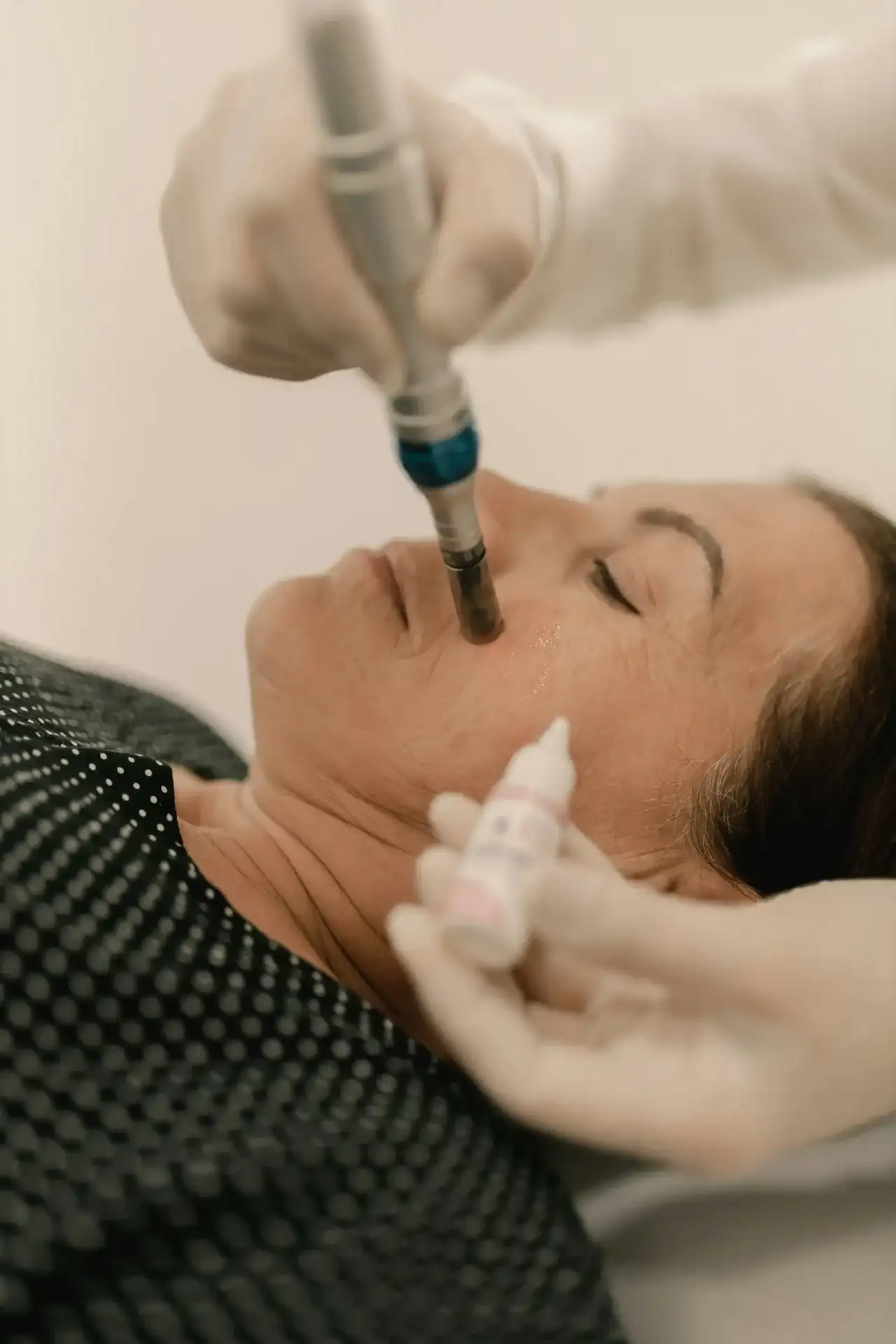
Skin needling is sold under at least three names, by businesses ranging from medical clinics to salons to a device in a box on your doorstep. The marketing across all of them sounds broadly identical.
What actually varies is not the language. It is the device, the depth, the person holding it and the hygiene around it. This guide covers those four, and the questions that get you a straight answer about each.
What it is
Skin needling uses fine needles to create controlled micro-injuries in the skin, prompting the skin’s own repair response. You will also see it sold as microneedling and as collagen induction therapy. Those names generally describe the same broad technique.
The mechanism is worth stating plainly because it explains everything that follows: the treatment works by deliberately breaking the skin barrier in a controlled way. That single fact is why depth matters, why sterility matters, and why assessment matters.
Home devices and clinic devices are not the same category
This is the comparison people most want, and the honest answer has two parts.
Depth. Devices designed for unsupervised home use are shallow by design, because a device sold to the general public has to be safe in untrained hands. Clinic devices can be set considerably deeper, which is precisely why they carry requirements around technique, assessment and hygiene that a home roller does not.
Sterility. A clinic treatment uses single-use needle cartridges opened at the time. A home roller is reused, typically for months, on skin that has not been prepared in a clinical way.
Neither of those makes deeper automatically better. Depth is chosen for the finding being addressed, and more is not a synonym for more effective. What it does mean is that the two are not comparable products, and a page presenting a home device as an equivalent to a clinic treatment, or a clinic treatment as simply a stronger version of a home one, is describing neither accurately.
The treatment works by deliberately breaking the skin barrier. Everything that matters follows from that.
The four questions that separate providers
Take these anywhere.
1. What device is it, and is it included in the ARTG? Therapeutic devices supplied in Australia should be included in the Australian Register of Therapeutic Goods, which is publicly searchable. A provider who cannot tell you what they are using is a provider you know very little about.
2. What depth are you using, and why that depth for me? The answer should be about your skin and the finding being addressed, not a standard setting applied to everyone.
3. Is the cartridge single-use, and will it be opened in front of me? The answer should be yes, and it should not be an awkward question.
4. What is being applied to my skin during and after the treatment, and why? This matters more here than in most treatments, because the barrier is open. It is reasonable to ask what a product is, what it is for, and how it is regulated.
If those four are answered clearly and without irritation, you have learned more than any before-and-after gallery would have told you.
Suitability is a real conversation
Skin needling is not appropriate for everyone, and the things that rule it out or change the approach are the sort of thing that only comes up if someone asks.
Active skin infection, some inflammatory skin conditions, a history of keloid or hypertrophic scarring, certain medications, recent treatments in the same area, and pregnancy all need to be discussed before anything is planned. Skin type matters to the discussion as well.
None of that can be assessed from a description over the phone or from a photograph, which is why an in-person assessment comes first.
What happens afterwards
Specific aftercare depends on the treatment actually performed and on your skin, which is why it is given to you directly rather than published as a general list. Instructions written for someone else’s treatment are a poor substitute for instructions written for yours.
What is worth knowing in advance is that sun protection matters more than usual after any treatment that affects the skin barrier. Around Lake Macquarie, where daily ultraviolet exposure is already a significant contributor to how skin ages, that is not a small footnote. The guide on how the outdoor lifestyle affects fine lines and wrinkles covers why.
Where it sits at Enrich Aesthetics
Skin needling is discussed at consultation as part of a wider plan rather than sold from a menu. Whether it is appropriate for you, and how it would be delivered, is determined at an in-person assessment alongside everything else being considered.
Published pricing for the treatments that may lawfully be priced sits in the skin rejuvenation guide, and includes chemical peels from $99, bio-stimulator threads from $500 and Rejuran at $700 or $550.
There is a related guide on LED light therapy, which sits in the same part of the market and has the same problem of marketing running ahead of plain explanation.
Why this page reads differently to others you will find
Enrich Aesthetics is a registered health practitioner’s practice rather than a salon, and is advertised under AHPRA’s guidelines for advertising higher risk non-surgical cosmetic procedures, in effect since 2 September 2025.
So this page carries no testimonials, no before-and-after imagery, no recovery timelines, no session counts and no language describing a procedure as safe, gentle or free of downtime. Those absences are the rules working, and they are worth noticing when you compare pages on this topic.
Kirsty Neagle is a Registered Nurse (Division 1) holding general registration with the Nursing and Midwifery Board of Australia, first registered in 2001. AHPRA registration NMW0001646562, verifiable on the public AHPRA register.
Practical details
The clinic is at 22 French Rd, Wangi Wangi, on the western side of Lake Macquarie. Clients travel in from Toronto, Rathmines, Coal Point, Fennell Bay, Morisset, Swansea, Belmont, Warners Bay and Newcastle.
Appointments run 9am to 5pm Monday to Saturday, closing at 3pm on Thursdays. The clinic is appointment-only rather than a walk-in space. Parking is in the driveway at the front or on the street, with details sent through with your appointment confirmation the day before. Website enquiries are answered within 24 hours.
The short version
Ask what the device is, what depth is being used and why, whether the cartridge is single-use, and what is going on your skin.
Four questions, all answerable before you book, and between them they cover almost everything that genuinely differs between one provider and the next. The rest is wording.
This guide is general education. It is not medical advice, and it does not replace an in-person consultation.