
People describe this change in the mirror before they can name it. Something has altered, it is not a line and it is not weight, and the face looking back is recognisably theirs but arranged slightly differently.
That description is more accurate than most of the vocabulary used for it. Facial ageing is not deflation. It is four structures changing on four timelines, and the visible result is what happens when they change together.
This guide covers the biology. What a consultation does with it is a separate question, covered in the guide on cheek and jawline volume loss.
The four things that change
Bone
The least intuitive one, and the one that surprises people most.
The facial skeleton is not fixed after adolescence. It continues to remodel through adult life, and the changes are not uniform across the face. The eye sockets tend to widen, the angle of the jaw alters, and the mid-face bone that supports the cheek changes position and projection.
That matters because everything else in the face sits on it. When the scaffolding shifts, the soft tissue draped over it does not stay where it was, regardless of how much of it there is.
Fat compartments
The fat of the face is not a single layer. It is organised into distinct compartments, superficial and deep, each with its own boundaries.
They do not behave as one unit and they do not change at the same rate. Some reduce noticeably while their neighbours change less, and the result of two adjacent compartments diverging is a visible transition where there used to be a smooth one.
This is the mechanism behind most of what people describe as hollowing in one area and fullness in another on the same face at the same time.
Ligaments
Connective tissue holds those fat compartments in position, anchoring them to deeper structures.
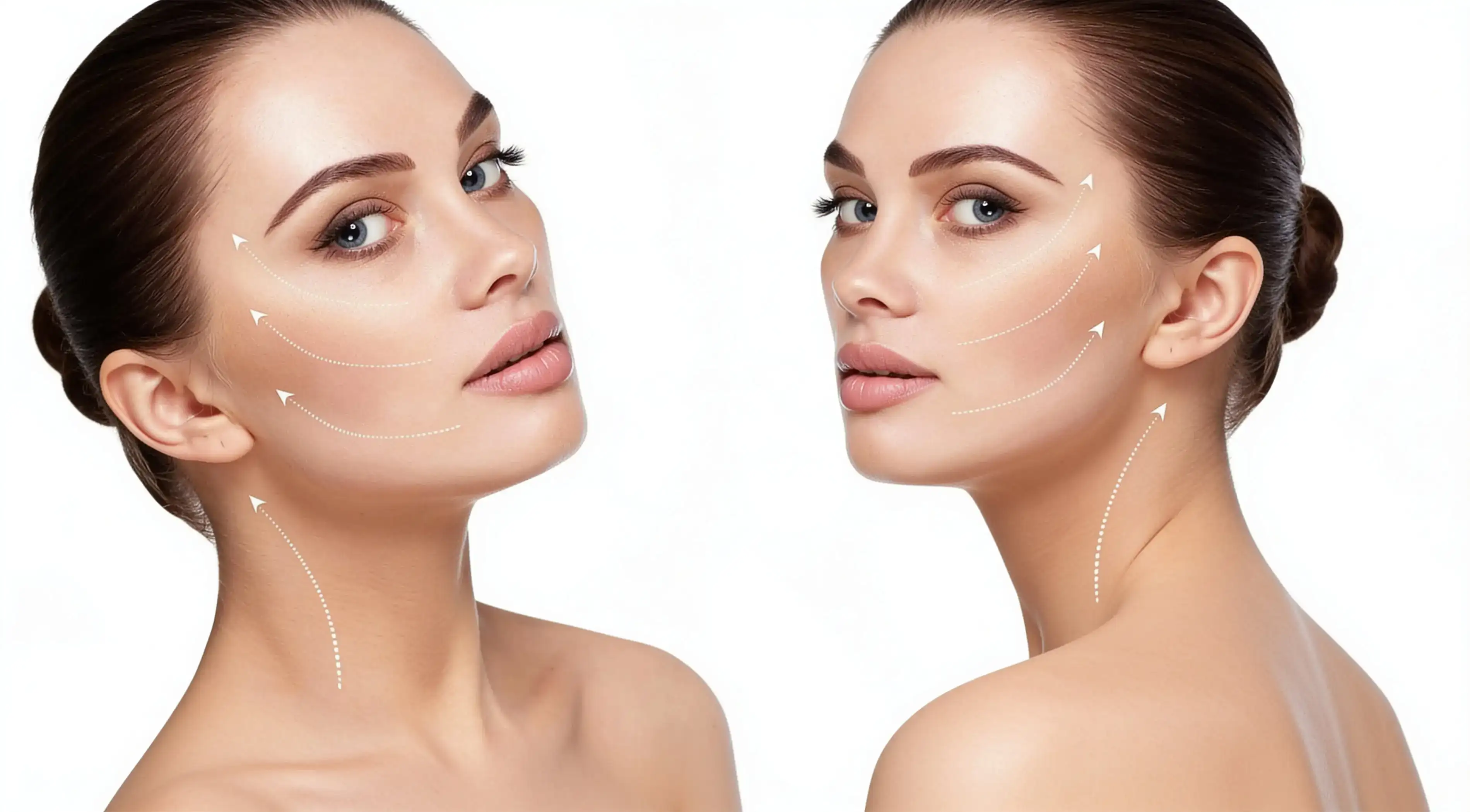
Over time that tissue lengthens. The compartments it supports descend, which means volume is not only reducing but relocating. Some of the fullness that appears lower in the face is fullness that used to be higher.
Volume does not simply disappear. A good deal of it moves, and where it ends up is as visible as what was lost.
Skin
Collagen and elastin decline with age, which alters how the skin drapes over everything above. Sun exposure accelerates that decline, and around Newcastle and the lake, ultraviolet exposure accumulates through unremarkable outdoor life rather than through deliberate sunbathing.
Skin quality is also why two faces with identical structural change can look quite different. The covering is doing different amounts of work.
Why the change reads as shape, not fullness
Put the four together and the outcome makes sense.
The bone underneath alters. The compartments sitting on it reduce unevenly. The ligaments holding them lengthen so they sit lower. The skin covering the whole arrangement loses some of its ability to conform to it.
That is a change in architecture. It is why the result looks like a different arrangement of the same face rather than a thinner version of it, and it is why “just fat loss” is such an unhelpful summary.
Where you notice it is often not where it started
The most practically useful consequence, and the reason assessments cover the whole face.
The folds beside the nose and mouth are frequently the first thing people point to. They are often not the origin of the problem. As mid-face compartments reduce and descend, tissue gathers differently above the fold, and the fold becomes more apparent as a consequence of change higher up.
The same logic applies along the jawline. Definition through the lower face is affected by what has happened in the mid face and by skin laxity, not only by what is happening at the jaw itself.
Which is why an assessment that only looks where you point is not an assessment.
Why the pattern is individual
There is no standard amount of volume a person needs at a given age, and no chart of what a face should look like at forty or at sixty.
Genetics set a good deal of it. Sun exposure, smoking, significant weight change, hormonal factors and general health move it further. Two people the same age can present with what sounds like an identical concern and be showing entirely different underlying changes.
The guide to skin ageing by decade covers the broad patterns without pretending they are schedules.
What this page deliberately does not do
It does not tell you what treatment you need, and it does not name or price one.
Options in the volumising category are prescription-only medicines. Australian law prohibits advertising prescription medicines to the public, and that covers naming them, describing them and stating what they cost. It is why this page explains a mechanism rather than a product, and why the volumising treatments page describes a consultation.
What understanding the mechanism does give you is the ability to follow the conversation at a consultation, and to ask why a particular area is being discussed when you came in about a different one. That question has a real answer, and it is usually the one above.
What an assessment looks at
- Facial proportion and structure, and where volume has and has not changed
- Skin quality and elasticity over those areas
- How the mid face and lower face relate to each other, rather than either in isolation
- Previous cosmetic treatments and your medical history
- What you have actually noticed, and over what period
- Whether the expectations you arrived with match what is realistic
Not every concern requires a treatment. If one is not considered appropriate, the reasons are explained and another approach or a referral may be recommended instead.
About this clinic
Enrich Aesthetics is a single-practitioner, nurse-led clinic at 22 French Rd, Wangi Wangi, on the western side of Lake Macquarie, with clients travelling in from across Newcastle.
Kirsty Neagle is a Registered Nurse (Division 1) holding general registration with the Nursing and Midwifery Board of Australia, AHPRA registration NMW0001646562, verifiable on the public AHPRA register. Her clinical background includes cardiac, vascular and plastics nursing at a Sydney teaching hospital.
Enrich Aesthetics is advertised under AHPRA’s guidelines for advertising higher risk non-surgical cosmetic procedures, in effect since 2 September 2025. This page carries no testimonials, no before-and-after imagery and no promised outcomes.
Appointments run 9am to 5pm Monday to Saturday, closing at 3pm on Thursdays. The clinic is appointment-only, and nothing is booked or priced over the phone or by email.
The short version
Bone remodels. Fat compartments reduce unevenly and descend as the ligaments holding them lengthen. Skin loses collagen and elastin and stops draping the way it did.
Four structures, four timelines, one visible result — which is a change in shape rather than a loss of fullness.
Where you notice it is often not where it began, the pattern is individual, and knowing the mechanism prepares you for the conversation without deciding it.
This guide is general education. It is not medical advice, and it does not replace an in-person consultation.